Based on German law as of 2026. For advice specific to your situation, book a free assessment.
Key Takeaways
- The GmbH requires a minimum share capital of €25,000, of which at least €12,500 must be paid in before registration. The alternative UG (haftungsbeschränkt) allows formation with as little as €1.
- The articles of association and shareholder resolutions must be notarized by a German notary — foreign shareholders need either to appear in person or provide an apostilled power of attorney.
- The company only comes into legal existence upon entry in the commercial register (Handelsregister), a process that typically takes 2-4 weeks.
- The managing director (Geschäftsführer) faces significant personal liability, including for payments made after insolvency and for breach of the duty of care under § 43 GmbHG.
- Need help? Book a free initial assessment with our team.
The Gesellschaft mit beschränkter Haftung (GmbH) is the corporate vehicle of choice for foreign companies entering the German market. It offers limited liability, operational flexibility, and widespread recognition in German business. But the GmbH formation process is more complex and formalized than incorporating a company in the US or UK. Several legal pitfalls await foreign investors who approach it with assumptions based on their home jurisdiction.
The Basics: What Is a GmbH?
A GmbH is a limited liability company governed by the GmbH Act (GmbH-Gesetz, GmbHG). It is the most common corporate form in Germany, with over one million registered GmbHs according to the Federal Statistical Office. The minimum share capital is €25,000, of which at least €12,500 must be paid in before registration. The company is managed by one or more managing directors (Geschäftsführer) and owned by shareholders (Gesellschafter) who hold shares (Geschäftsanteile).
For international context: the GmbH is roughly comparable to a US LLC or a UK Ltd, but with more rigid statutory requirements and a different governance structure.
Setting Up a Company in Germany?
We guide foreign investors through GmbH formation — avoiding the legal pitfalls that cost time and money. Free initial consultation.
Book a Free Consultation →The Formation Process
Notarization Is Mandatory
This is the first surprise for most US and UK investors. The articles of association (Gesellschaftsvertrag) and the shareholder resolutions appointing the managing director must be notarized by a German notary (Notar). The notary is not merely a witness — they are a public official who verifies the legality of the documents, confirms the identity of the signatories, and provides legal guidance on the formation process.
All shareholders (or their authorized representatives) must appear before the notary. For foreign shareholders, this means either traveling to Germany or issuing a notarized power of attorney — which itself must be notarized in a form acceptable under German law. Powers of attorney from the US typically require an apostille under the Hague Convention to be recognized in Germany.
Share Capital Requirements
The €25,000 minimum share capital is not negotiable. At least half (€12,500) must be deposited into the GmbH's bank account before the company can be registered with the commercial register (Handelsregister). The managing director must confirm the deposit to the notary.
If the full €25,000 is not paid in at formation, shareholders are personally liable for the outstanding amount. This is not a theoretical risk — in insolvency proceedings, the insolvency administrator will pursue unpaid share capital contributions from shareholders.
For foreign investors accustomed to nominal share capital (like the US Delaware LLC with no minimum or the UK Ltd with £1), the €25,000 requirement represents a real capital commitment. The alternative — a UG (haftungsbeschränkt), the "mini-GmbH" with €1 minimum capital — exists but has limitations that make it less suitable for serious business operations.
Commercial Register Registration
The GmbH comes into legal existence only upon registration with the commercial register at the local court (Amtsgericht). The registration process typically takes two to four weeks. During the period between notarization and registration, the entity exists as a "GmbH in Gründung" (GmbH i.G.) — a pre-registration company. The managing director can begin business activities during this period, but personal liability may attach for obligations incurred before registration if the company's assets are insufficient.
Common Pitfalls for Foreign Investors
Pitfall 1: Underestimating the Managing Director's Personal Liability
In the US, officers of a corporation generally enjoy broad protection from personal liability. The German Geschäftsführer operates in a very different environment. Managing directors have extensive personal duties and face personal liability in multiple scenarios.
Under § 43 GmbHG, managing directors must exercise the care of a prudent businessperson. Breach of this duty creates personal liability to the company — and this liability cannot be waived in advance by the shareholders. In insolvency situations, the managing director is personally liable for payments made after the company becomes insolvent or over-indebted (§ 15b InsO). The filing obligation is strict: the managing director must file for insolvency within a maximum of three weeks after the onset of insolvency (Zahlungsunfähigkeit) or six weeks after over-indebtedness (Überschuldung).
For foreign parent companies appointing a manager to run their German subsidiary: the person you appoint as Geschäftsführer takes on real personal risk. Ensure they understand their obligations, have access to current financial information, and have authority to fulfill their statutory duties. A Geschäftsführer who is kept in the dark by the parent company is still personally liable if things go wrong.
Pitfall 2: Insufficient Articles of Association
Many foreign investors use minimal template articles of association to save time and cost. While this gets the company registered, it creates problems later. Standard templates often lack provisions for shareholder disputes, transfer restrictions, non-compete obligations for shareholders, deadlock resolution mechanisms, and drag-along and tag-along rights.
In the US and UK, many of these issues are addressed in a separate shareholders' agreement. In Germany, while shareholders' agreements are possible, they are not effective against the company itself — only the articles of association bind the GmbH. This means that transfer restrictions, consent requirements, and other protective provisions must be in the articles (which are public) rather than in a side agreement.
Pitfall 3: Ignoring German Tax Registration
After commercial register registration, the GmbH must register with the local tax office (Finanzamt) and obtain a tax number. The tax office will send a questionnaire (Fragebogen zur steuerlichen Erfassung) that must be completed carefully. The company will also need a VAT identification number (Umsatzsteuer-Identifikationsnummer) for intra-EU transactions.
Foreign investors often underestimate the time this takes. The tax registration process can take several weeks, and without a tax number, the company cannot issue proper invoices or claim input VAT refunds. Plan for this delay.
Pitfall 4: Employment Law Surprises
Hiring the first employee in Germany triggers a cascade of legal obligations that do not exist (or exist in weaker form) in the US. These include mandatory social security contributions (approximately 20% of gross salary, paid by the employer), strict dismissal protection once the employee has been employed for six months and the company has more than ten employees, mandatory continued salary payment during illness (up to six weeks), minimum vacation entitlement (20 days per year for a five-day week, often 25-30 days by market standard), and works council rights if you reach five employees.
These obligations apply from the first day of employment. There is no grace period for new companies. Build employment costs into your business plan from the start — the "all-in" cost of a German employee is typically 25-35% above gross salary.
Pitfall 5: The Bank Account Problem
Opening a German business bank account for a foreign-owned GmbH has become increasingly difficult due to anti-money-laundering regulations (Geldwäschegesetz). Banks conduct extensive know-your-customer (KYC) checks on foreign beneficial owners, which can take weeks or even months. Some banks refuse to open accounts for companies with complex foreign ownership structures.
Start the bank account opening process early — ideally before the notarization appointment, since you need the account to deposit the share capital. Consider which bank to approach carefully: some German banks are more experienced with international structures than others.
Pitfall 6: Failing to Appoint a Local Managing Director
German law does not require the Geschäftsführer to be a German resident. However, practical considerations strongly favor having at least one managing director based in Germany. A non-resident managing director creates complications for banking (many banks require at least one German-resident signatory), tax (the place of effective management determines tax residency), and day-to-day operations.
If you appoint a foreign managing director, ensure they have the infrastructure to fulfill their German-law obligations, including access to German legal and tax advisors, and the ability to travel to Germany on short notice.
Timeline and Costs
A realistic timeline for GmbH formation — from initial planning to full operational readiness — is six to twelve weeks. This assumes no complications with the bank account or foreign document authentication.
Formation costs typically include notary fees (approximately €1,000–€2,000 depending on share capital and complexity), commercial register fees (approximately €150), legal fees for drafting the articles of association (€2,000–€5,000 for customized articles), and bank account opening (no fee, but time-consuming). Budget at least €5,000–€10,000 for the complete formation process, excluding the share capital itself.
Ready to Take Action?
Send us the details of your dispute and we’ll outline your options within 48 hours.
Send Us Your Case Details →The UG (Haftungsbeschränkt) Alternative
The Unternehmergesellschaft (haftungsbeschränkt), or "UG," is a variant of the GmbH with a minimum share capital of just €1. It was introduced in 2008 to compete with the UK Ltd. While it offers the same limited liability, it carries a stigma in German business — counterparties often view UGs as undercapitalized startups. Additionally, the UG must retain 25% of annual profits until the share capital reaches €25,000, at which point it can convert to a regular GmbH.
For serious foreign investors, the regular GmbH is almost always the better choice. The UG's cost savings (lower share capital) are marginal compared to the reputational and practical disadvantages.
How APOS Legal Can Help
We guide foreign investors through every step of GmbH formation — from drafting the articles of association to managing the notarization process, commercial register filing, and shareholder agreement negotiation. We identify potential pitfalls before they become costly problems and ensure your German entity is set up to protect your interests from day one. Book a free consultation →
Key Takeaways
Setting up a GmbH is straightforward if you plan ahead and work with experienced German advisors. The main risks arise from approaching the process with US or UK assumptions — particularly regarding managing director liability, employment law, and the formality of the corporate governance framework. Take the formation process seriously, invest in proper articles of association, and ensure your managing director understands their obligations from day one.
This article is for informational purposes only and does not constitute legal advice. Corporate formation is highly fact-specific — please consult a qualified attorney for advice on your particular situation.
Published: March 1, 2026 | Author: Fatih Bektas, Attorney-at-Law & Certified Specialist in Employment Law, APOS Legal, Heidelberg & Berlin
Frequently Asked Questions
Setting Up a Company in Germany?
Whether you need to sue or have been sued in Germany — we can help. Free case assessment, usually within 48 hours.
Book Free Case Assessment →Related Practice Areas

How to Sue a Company in Germany: The Complete Guide for US and UK Businesses (2026)
Step-by-step guide for US & UK companies suing in Germany. Courts, attorney rules, costs, timelines, and the loser-pays rule.
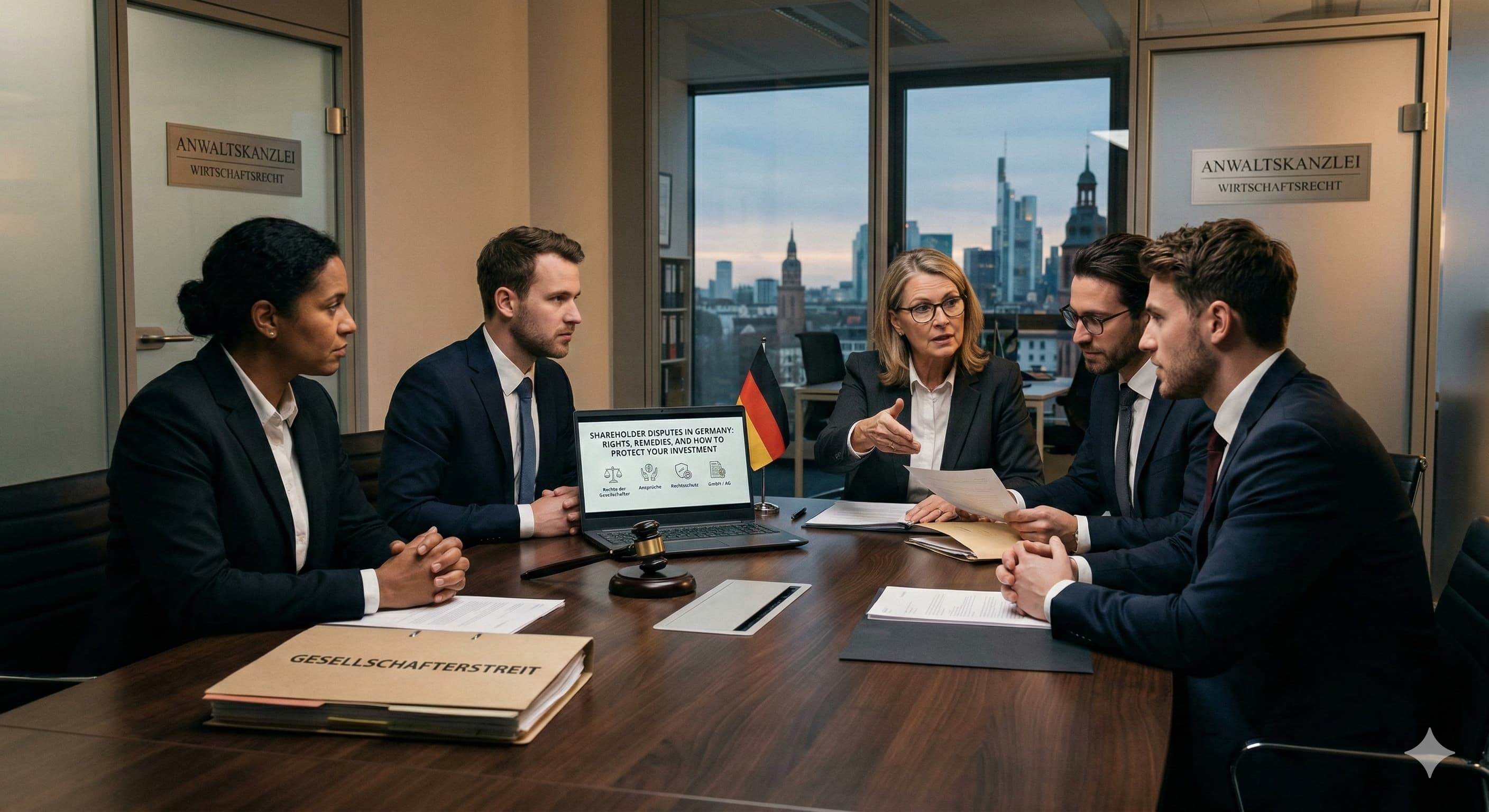
Shareholder Disputes in Germany: Rights, Remedies, and How to Protect Your Investment
Shareholder disputes in Germany: minority rights, squeeze-outs, fiduciary duties, and how to enforce your rights in GmbH or AG.

I've Been Sued in Germany — What Do I Do? Emergency Guide for Foreign Companies (2026)
Received a German lawsuit? Emergency guide for US & UK companies: deadlines, default judgment risks, and what to do next.