Based on German law as of 2026. For advice specific to your situation, book a free assessment.
Key Takeaways
- German civil courts have no juries and no discovery — the judge actively investigates the case and controls the proceedings.
- The court system has four levels: Amtsgericht (up to €10,000), Landgericht (above €10,000, attorney mandatory), Oberlandesgericht (appeals), and Bundesgerichtshof (final appeals on legal questions).
- Germany follows the "loser pays" principle — the losing party reimburses all statutory costs for both sides.
- First-instance proceedings at a Landgericht typically take 6–12 months, significantly faster than US or UK litigation.
- Need help? Book a free initial assessment with our team.
If you are a US or UK business facing a legal dispute in Germany, one of the first things you will notice is that almost nothing works the way you expect. There are no juries. There is no discovery. The judge is not a passive referee — the judge runs the show. And the loser pays everyone's costs.
This guide explains how the German court system works, how it differs from what you know, and what you need to understand before stepping into a German courtroom.
The Court Structure: Four Levels
Germany's civil court system is organized into four tiers. Understanding which court handles your case is the first practical question.
Amtsgericht (Local Court)
The Amtsgericht handles civil disputes with a value of up to €10,000. For most international commercial disputes, this court is irrelevant — the amounts are simply too small. However, there are exceptions: the Amtsgericht has exclusive jurisdiction over certain matters regardless of value, such as landlord-tenant disputes.
Attorney representation at the Amtsgericht is not mandatory. You can technically represent yourself. That said, for any cross-border matter, having a German attorney is strongly recommended.
A single judge (Einzelrichter) decides cases at this level.
Landgericht (Regional Court)
The Landgericht is where most international commercial disputes are heard. It has jurisdiction over all civil matters with a value above €10,000. Attorney representation is mandatory (Anwaltszwang) — you cannot appear before a Landgericht without a German-admitted lawyer (Rechtsanwalt).
Key feature for international businesses: The Landgericht has specialized Chambers for Commercial Matters (Kammern für Handelssachen). These chambers consist of one professional judge and two lay judges (ehrenamtliche Richter) who are experienced business professionals — often CEOs, managing directors, or senior executives. You or your attorney can request assignment to a commercial chamber, and for international trade disputes, this is almost always advisable.
There are 115 Landgerichte across Germany. The one with jurisdiction depends on where the defendant is located or where the contract was to be performed.
Oberlandesgericht (Higher Regional Court)
The Oberlandesgericht (OLG) handles appeals (Berufung) against Landgericht decisions. An appeal can challenge both the factual findings and the legal analysis of the lower court. This is an important difference from some common law systems where appellate courts only review legal questions.
There are 24 OLGs in Germany. Notable ones for international commercial matters include the OLG Frankfurt, OLG Munich, OLG Hamburg, and the Kammergericht in Berlin.
The OLG also has original jurisdiction over certain matters, including enforcement of foreign arbitral awards.
Bundesgerichtshof (Federal Court of Justice)
The Bundesgerichtshof (BGH) in Karlsruhe is Germany's highest civil court. It only accepts cases involving legal questions of fundamental importance (Revision). Factual findings from the lower courts are binding. Access to the BGH is limited — either the OLG must grant leave to appeal, or the BGH itself must accept the case.
In practice, very few international commercial disputes reach the BGH. If your case involves a novel legal question — for example, the interpretation of a new EU directive — the BGH may take it. Otherwise, the OLG decision is final.
No Jury: The Judge Decides Everything
This is perhaps the most striking difference for American clients. There are no jury trials in German civil cases. Not at any level. Not for any amount.
All findings of fact and all legal conclusions are made by professional judges (with the addition of lay commercial judges at the Landgericht, if you request a commercial chamber).
For many international businesses, this is actually an advantage. Your case is decided by a legal professional who has read every brief, studied every document, and understands the law. There is no risk of an emotionally swayed jury, no theatrics, and no runaway verdicts. German judgments are generally predictable and well-reasoned.
The flip side: you cannot appeal to a jury's sympathy. The case will be decided on the law and the evidence, nothing more.
Facing a Dispute in German Courts?
We guide US and UK companies through the German court system — from filing to enforcement. Free initial assessment.
Book a Free Consultation →No Discovery: Bring Your Own Evidence
If you have litigated in the United States, you are accustomed to discovery — the process where both sides can demand documents, take depositions, and compel the other party to reveal information. This process can take months or years and cost hundreds of thousands of dollars.
Germany has no discovery process. None.
Each party is responsible for presenting their own evidence. You cannot compel the opposing party to produce documents. You cannot depose their witnesses before trial. You cannot send interrogatories.
This has profound implications for how you prepare a case:
- Gather everything before you file. Emails, contracts, invoices, correspondence, internal memos — if it supports your claim, you need to have it in hand before the lawsuit begins.
- Document preservation matters. If you anticipate litigation, preserve all relevant documents immediately. You will not get a second chance.
- Strategic considerations differ. In the US, discovery often reveals the opponent's weak points. In Germany, you go into court with what you have. This makes pre-litigation investigation and case assessment more important.
There are narrow exceptions. Under § 142 ZPO, the court can order a party to produce a specific document if the requesting party can precisely describe it and the other party has referred to it. But this is nothing like American-style discovery — it is targeted, limited, and rarely used.
What About Document Production Under the IBA Rules?
If your dispute is in arbitration rather than court litigation, the situation is different. Arbitration proceedings (ICC, DIS, LCIA) often apply the IBA Rules on the Taking of Evidence, which provide a limited document production mechanism similar to common law discovery, but much narrower. If document access is critical to your case, arbitration may be the better forum.
The Loser-Pays Rule
Germany follows the loser-pays principle (Kostentragungspflicht), codified in § 91 ZPO. The losing party pays:
- All court fees (Gerichtskosten)
- The winning party's statutory attorney fees (Rechtsanwaltsvergütung)
- Costs of evidence, including court-appointed experts
This is fundamentally different from the American Rule, where each side bears its own attorney fees regardless of outcome.
What This Means in Practice
If you have a strong case, the loser-pays rule works in your favor. Win your lawsuit, and the other side reimburses your costs. This significantly reduces the financial risk of bringing a meritorious claim.
If your case is weak, the financial exposure is doubled. You pay your own lawyer, the court fees, and the other side's statutory fees. This makes it essential to get a realistic assessment of your chances before filing.
For defendants, the loser-pays rule provides a natural incentive to settle early if liability is likely. Why fight a losing battle and pay both sides' costs?
Statutory Fees, Not Hourly Billing
German attorney fees are calculated from statutory fee schedules based on the amount in dispute (Streitwert), not on hourly rates. This makes litigation costs far more predictable than in the US or UK — you can calculate your expected costs in seconds. Our detailed cost breakdown shows exact figures for every dispute value.
For example, a €200,000 dispute at the Landgericht typically costs approximately:
| Item | Amount |
|---|---|
| Court fees | ~€4,200 |
| Your attorney (statutory fees) | ~€6,500 |
| Opposing attorney (statutory fees) | ~€6,500 |
| Total first instance | ~€17,200 |
Compare this to a US federal case of the same value, where attorney fees alone can easily exceed $100,000.
You can agree with your attorney on fees above the statutory rates — and for complex international cases, this is common. However, the statutory fees are what the loser must reimburse. Any premium you agree to pay your own attorney is your cost regardless of outcome.
The Active Judge
In common law systems, the judge is often described as a passive referee who lets the parties present their case. In Germany, the judge is an active participant.
The presiding judge:
- Studies all written submissions before the hearing. By the time you walk into the courtroom, the judge has read every brief and every document.
- Gives preliminary assessments. German judges regularly indicate their tentative view of the case (Hinweisbeschluss). This is not a final ruling, but it gives both parties a clear signal of where the court is leaning.
- Asks questions. The judge — not the attorneys — conducts the primary questioning of witnesses. Attorneys may ask supplementary questions, but the judge leads.
- Encourages settlement. Judges actively propose settlement terms and push parties to resolve the case without a judgment. Approximately 30–40% of German civil cases end in a court-mediated settlement, according to data from the Federal Statistical Office.
For international clients, the judge's preliminary assessment is one of the most valuable features of German procedure. If the judge signals that your claim is strong, it puts enormous pressure on the opponent to settle. If the judge signals weaknesses, you know early enough to adjust your strategy.
Typical Timeline: How Long Does It Take?
German civil litigation is generally faster than its US or UK equivalent.
| Phase | Duration |
|---|---|
| Filing to service on defendant | 2–4 weeks |
| Defendant's response | 2–4 weeks |
| Written briefs exchange | 2–4 months |
| Oral hearing | 4–8 months after filing |
| Judgment | Typically 2–4 weeks after final hearing |
| Total first instance | 6–12 months |
| Appeal (OLG) | Additional 6–12 months |
Complex cases with expert witnesses (e.g., construction disputes, patent cases, product liability) may take 12–18 months at first instance. Appeals can add another year.
For comparison: the average US federal civil case takes 24–36 months from filing to trial. UK High Court proceedings can take 12–24 months. German courts are at the faster end of the spectrum.
Urgent Matters: Interim Injunctions
If you need emergency relief — for example, to stop a competitor from infringing your trademark, to prevent assets from being moved, or to enforce a non-compete — German courts can issue interim injunctions (einstweilige Verfügungen) within days to weeks.
The standard is that you must show urgency (Dringlichkeit). Most courts presume urgency if you apply within one month of learning about the infringement. Wait longer, and the court may deny the injunction on the grounds that it cannot be that urgent if you waited.
Ready to Take Action?
Send us the details of your dispute and we’ll outline your options within 48 hours.
Send Us Your Case Details →Key Differences at a Glance
| Feature | Germany | USA | UK |
|---|---|---|---|
| Jury trials | No | Yes | Yes (rarely in civil) |
| Discovery | No | Yes (broad) | Yes (disclosure) |
| Cost rule | Loser pays | Each pays own | Loser pays |
| Fee basis | Statutory (dispute value) | Hourly | Hourly |
| Judge's role | Active, investigative | Passive referee | Active but less than DE |
| Typical duration | 6–12 months | 24–36 months | 12–24 months |
| Punitive damages | No | Yes | No |
| Class actions | No (limited model case) | Yes | Group Litigation Order |
What This Means for Your Case
If you are a US or UK business facing a dispute in Germany, the German system offers several structural advantages:
- Speed. Your case will likely be resolved in 6–12 months, not years.
- Predictable costs. Statutory fees mean you can budget accurately before you start.
- Professional decision-makers. Judges, not juries, decide your case based on law and evidence.
- Settlement incentives. The loser-pays rule and active judicial involvement push cases toward early resolution.
The key challenge is the absence of discovery. You must build your case from your own records and evidence. This makes preparation — and choosing the right attorney — even more critical. For a step-by-step walkthrough, see our guide on how to sue in Germany. If you have been sued, read our emergency guide for defendants.
How APOS Legal Can Help
Navigating the German court system for the first time can be complex — but it does not have to be. We represent international companies at every level of the German court hierarchy, from Amtsgericht to Bundesgerichtshof. With over 20 years of courtroom experience, we know how German judges think, how proceedings unfold, and how to position your case for success. All communication is in English. Book a free case assessment →
Need Guidance on Your German Dispute?
If you are navigating the German court system for the first time, we can help you understand the process, assess your chances, and develop a clear strategy. Fatih Bektas is a German-qualified attorney with over 20 years of litigation experience, representing international clients in German courts and arbitration. All communication in English.
Frequently Asked Questions
Facing a Dispute in German Courts?
Whether you need to sue or have been sued in Germany — we can help. Free case assessment, usually within 48 hours.
Book Free Case Assessment →Related Practice Areas
How to Sue a Company in Germany: The Complete Guide for US and UK Businesses (2026)
Step-by-step guide for US & UK companies suing in Germany. Courts, attorney rules, costs, timelines, and the loser-pays rule.
Interim Injunctions in Germany: How to Get Fast Relief in Urgent Disputes
German interim injunctions (einstweilige Verfügung): how to get emergency court orders within days, requirements, and penalties.
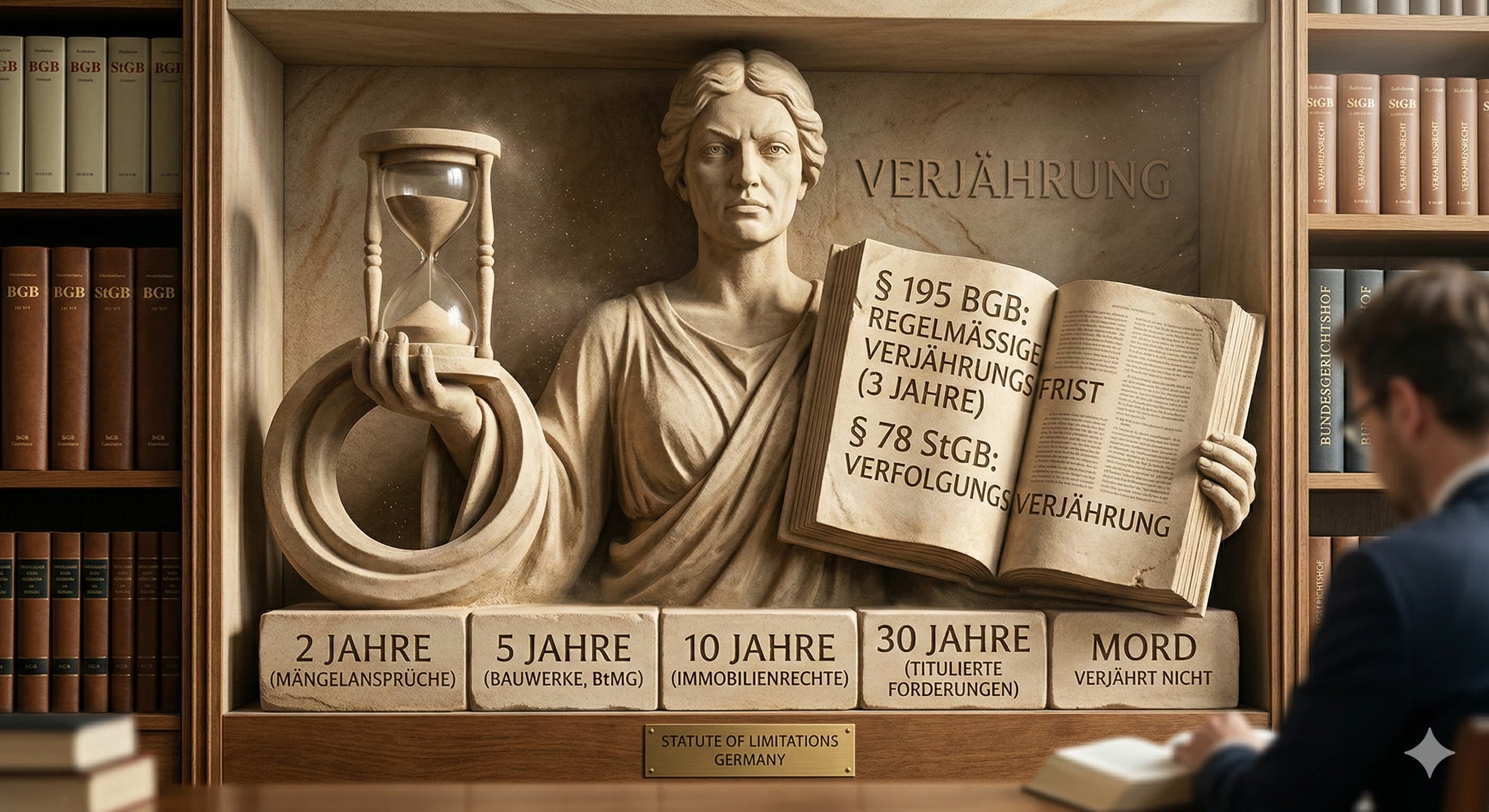
Statute of Limitations in Germany: Key Deadlines That Can Kill Your Claim
German statute of limitations (Verjährung): the 3-year rule, when the clock starts, how to stop it, and critical deadlines for your claim.